
P0012 Code: Intake Camshaft Timing and Checks Before Repair
Contents
P0012 indicates over-retarded intake camshaft timing on Bank 1. Check warning severity, oil information and the exact vehicle before choosing a repair: manufacturer examples include oil-level checks, actuator faults and software-related false detections.
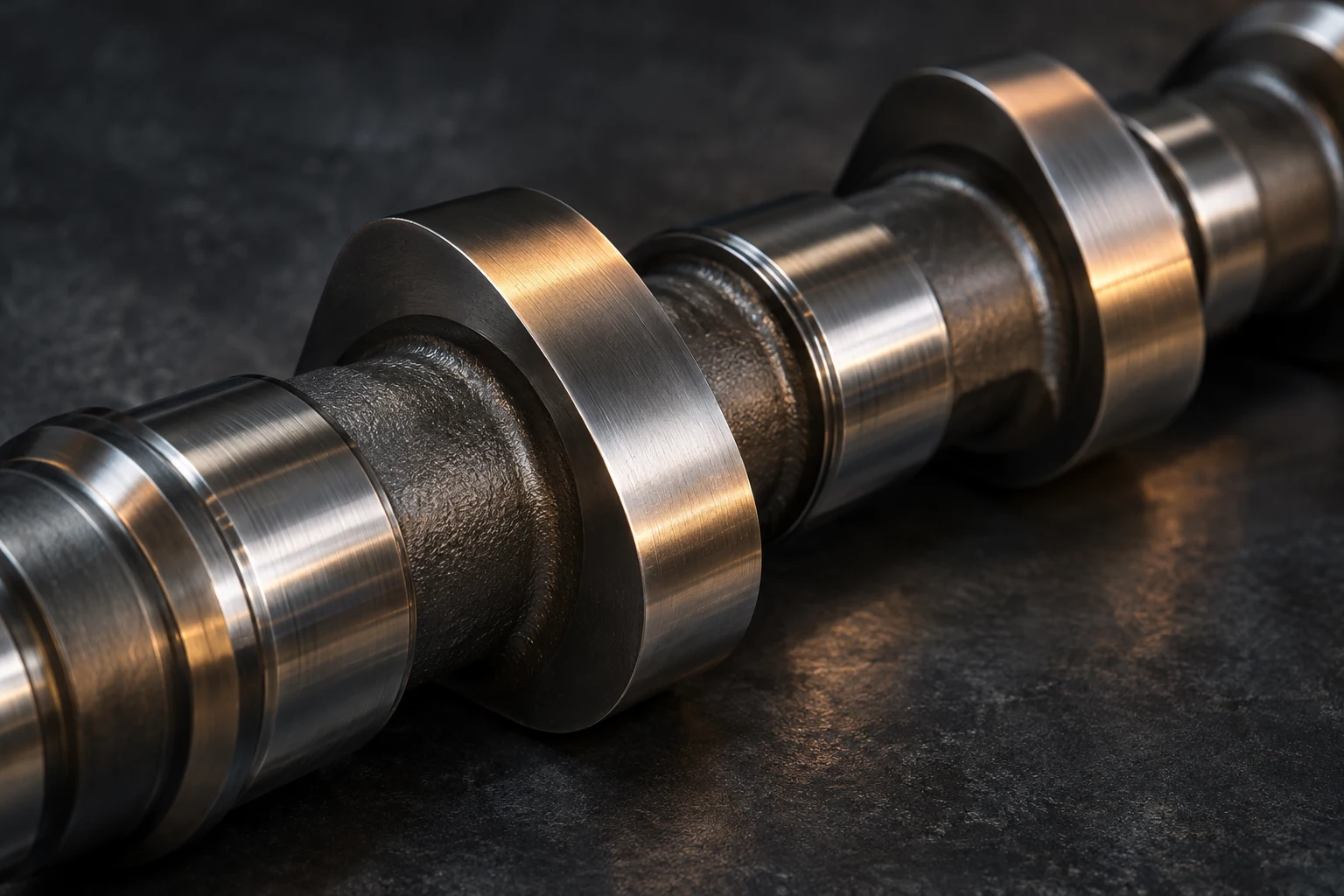
General P0012 orientation. Examples are limited to Ford 2024-2025 gasoline OBD definitions; 2019-2020 F-150 5.0L under SSM 49583; specified 2018 Mazda6/CX-5 under 01-014/19; and VIN-limited 2014 Mazda3/2015 Mazda6/CX-5 under 01-007/15. Oil and warning examples use the 2018 CX-5 North American manual.
Follow the warning instructions for your exact vehicle. Stop safely and arrange assistance with an oil-pressure warning, repeated stalling, severe rough running or new loud mechanical noise. Do not warm an engine with an oil-pressure warning merely to check its oil. Running-engine diagnosis, timing repairs and programming require a qualified repairer.
What the timing description means
Ford's gasoline OBD reference identifies P0012 as intake camshaft timing that is too retarded on Bank 1. In plain language, the timing result is farther in the retarded direction than the control system expects. It is a timing-performance finding, not a measurement of how worn a camshaft is.
Keep the full description from your vehicle's scan report. A different code, such as P0340, concerns the camshaft-position sensor circuit. Seeing the word camshaft in both descriptions does not make the two faults interchangeable.
Decide whether to stop before looking for a repair
P0012 alone does not establish a safe driving distance. Check the dashboard warnings and the instructions in your own manual. If the engine stalls repeatedly, runs severely rough or develops a new loud mechanical noise, stop safely and arrange assistance rather than testing it further on the road.
Treat an oil-pressure warning separately from the code. The 2018 Mazda CX-5 warning instructions, for example, prohibit running the engine with low oil pressure. If its warning remains on despite a normal oil level or after correcting the level, Mazda directs the owner to stop the engine and have the vehicle towed. A satisfactory dipstick reading is not proof of satisfactory pressure.
Record the oil level and recent servicing
Before buying parts, check what can safely be established from the owner's manual and service records:
- Measure the oil level using the procedure for your exact engine, including its temperature and waiting-time requirements.
- Check the invoice for the oil specification used at the last service.
- Note any recent topping-up, oil loss or timing-system work, and whether the warning began before or after it.
For a concrete example, the 2018 CX-5 oil-check instructions require level ground, a warmed engine that has been switched off for at least five minutes, and a dipstick that is wiped and fully reinserted before reading. They also warn against overfilling. This routine measurement procedure is not a reason to warm up an engine that already has an oil-pressure warning.
Do not transfer that waiting time or an oil grade from another model to your car. If you cannot identify the correct procedure or safely reach the measuring point, ask a workshop to check it.
Why the same code can lead to different repairs
Manufacturer documents illustrate three distinct possibilities. Each applies only within its stated vehicle scope; none is a list of parts every P0012 vehicle needs.
Ford SSM 49583 concerns 2019-2020 F-150 trucks with the 5.0-litre engine. It covers specified timing codes, including P0012, sometimes with noise near the front of the valve covers. Ford starts with checking and correcting the oil level. If the condition remains, the message directs technicians to the VCT solenoid associated with the recorded code, with further diagnosis if the problem persists. It does not begin with replacing every timing component.
Mazda bulletin 01-014/19 describes a software-related false detection on certain 2018 Mazda6 and CX-5 vehicles with a coolant control valve and a Mitsubishi-manufactured powertrain control module. It excludes the SKYACTIV-G 2.5T. The Mazda6 build cutoff is before 21 December 2018; the CX-5 cutoff is before 29 September 2018, with VIN limits specified in the bulletin. The repair procedure combines electric VVT actuator replacement with PCM reprogramming. A dealer must confirm applicability and follow the complete procedure; this is not a software-only shortcut.
A different Mazda bulletin, 01-007/15, identifies possible VVT actuator spring-shaft fatigue in selected 2014 Mazda3, 2015 Mazda6 and 2015 CX-5 vehicles built between 31 January and 21 March 2014, within listed VIN ranges. Its technician procedure compares actual and desired valve timing before deciding on actuator replacement.
Ask for a diagnosis you can follow
Bring the complete scan report, the symptoms you observed and the service information you collected. Ask the repairer to explain:
- Which engine-specific test or applicable service bulletin is being used?
- Does the measured camshaft timing follow the commanded value under the required test conditions?
- What finding supports the proposed repair, and what check will confirm the result?
Comparing actual and desired timing is part of the scoped Mazda procedure above, not an instruction to rev the engine yourself. Leave running-engine measurements, actuator removal and software programming to a qualified repairer. Keep the final diagnostic record so that a returning warning can be compared with the original fault.
Frequently asked questions
Is P0012 the same as P0011?
No. Ford describes P0011 as intake timing too far advanced and P0012 as too far retarded, both on Bank 1. Record the exact number; they describe opposite timing errors.
Does P0022 refer to the same bank as P0012?
No. In Ford's code definitions, P0022 describes over-retarded intake timing on Bank 2. Use the engine-specific service information to identify the correct bank rather than guessing from the side of the vehicle.
Does a service bulletin mean the repair will be free?
A bulletin is not an individual warranty approval. Ask the manufacturer or dealer to check your VIN, applicable coverage and the proposed work before authorising the repair.
Check the original documents
Sources
- Ford 2024-2025 gasoline OBD summary, July 16 2024 V2
Pages 79-80: intake timing P0012, related timing/circuit codes and monitor context.
- Ford SSM 49583
Page 1: 2019-2020 F-150 5.0L, oil-level check and conditional diagnostic sequence.
- Mazda 01-014/19, August 1 2019
Pages 1-2: 2018 Mazda6/CX-5 VIN/build scope, coolant control valve, Mitsubishi PCM only, 2.5T excluded, false detection and combined actuator replacement/PCM reprogramming.
- Mazda 01-007/15, July 14 2015
Pages 1-2: exact model/VIN/production ranges, spring-shaft fatigue, actual-versus-desired timing check and conditional repair.
- 2018 Mazda CX-5 owner manual: engine oil
Inspecting Engine Oil Level: level surface, engine-off wait, dipstick and overfill precautions; model-specific example.
- 2018 Mazda CX-5 owner manual: warning lights
Engine Oil Warning Light: low-pressure safety and towing if warning persists at normal/corrected level.
Sources checked on 2026-11-07. Follow the instructions for your exact model.