P0174 Code: System Too Lean on Bank 2 and What to Check Next
Contents
P0174 reports a lean condition on Bank 2. The useful next step is to preserve the diagnostic data and find out why fuel control has reached its limit, rather than choosing a sensor from the code alone.
General orientation for gasoline vehicles reporting P0174. Ford fuel-monitor documentation, the specific vehicles listed in Ford TSB 04-17-4, GM’s 2007–2009 Cadillac 4.6L LH2 bulletin and a DENSO Toyota case are separate examples, not universal repair instructions.
Do not continue driving through severe shaking, stalling or loss of power. Stop safely and arrange assistance. Running-engine tests, leak testing and fuel-pressure work require suitable equipment and a qualified technician.
What does P0174 mean?
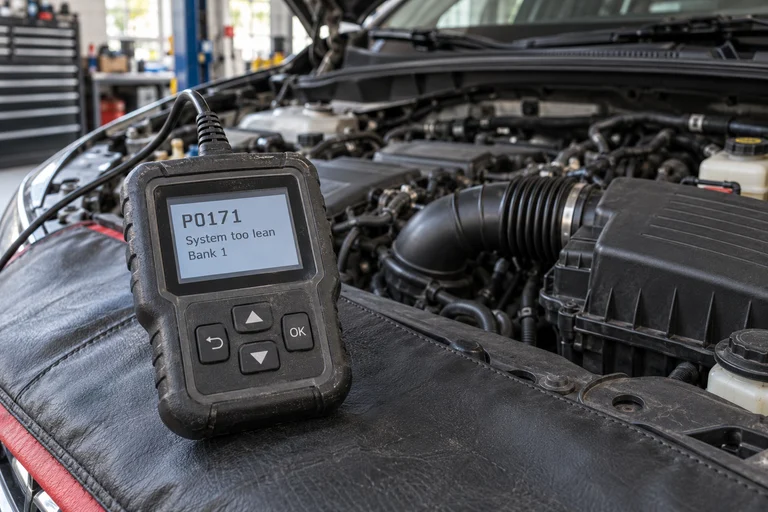
The diagnostic description is System Too Lean, Bank 2. In plain language, the monitored mixture has too much air relative to fuel. Ford’s gasoline OBD documentation lists P0174 in the fuel-control monitor, alongside P0171 for Bank 1.
Fuel trim is the controller’s adjustment to fuel delivery. The Ford monitor summary describes how those corrections are used to detect a lean condition. Its calibration thresholds are examples for the systems covered, not universal pass-or-fail values for every car.
Use the service information for your exact engine to locate Bank 2. The code does not name a replacement part or tell you to work on whichever side of the engine is easiest to reach.
Save the codes before clearing them
Keep a scan report containing all stored codes and any available freeze-frame data. Record the year, model and engine, plus whether the warning appeared at a cold start, idle or while driving.
Ford TSB 04-17-4, for its listed 2000–2004-era Ford, Lincoln and Mercury applications, warns that resetting the system removes data needed for its diagnostic procedure. Freeze-frame information records conditions when the fault was detected; a temperature-dependent leak may otherwise be harder to reproduce.
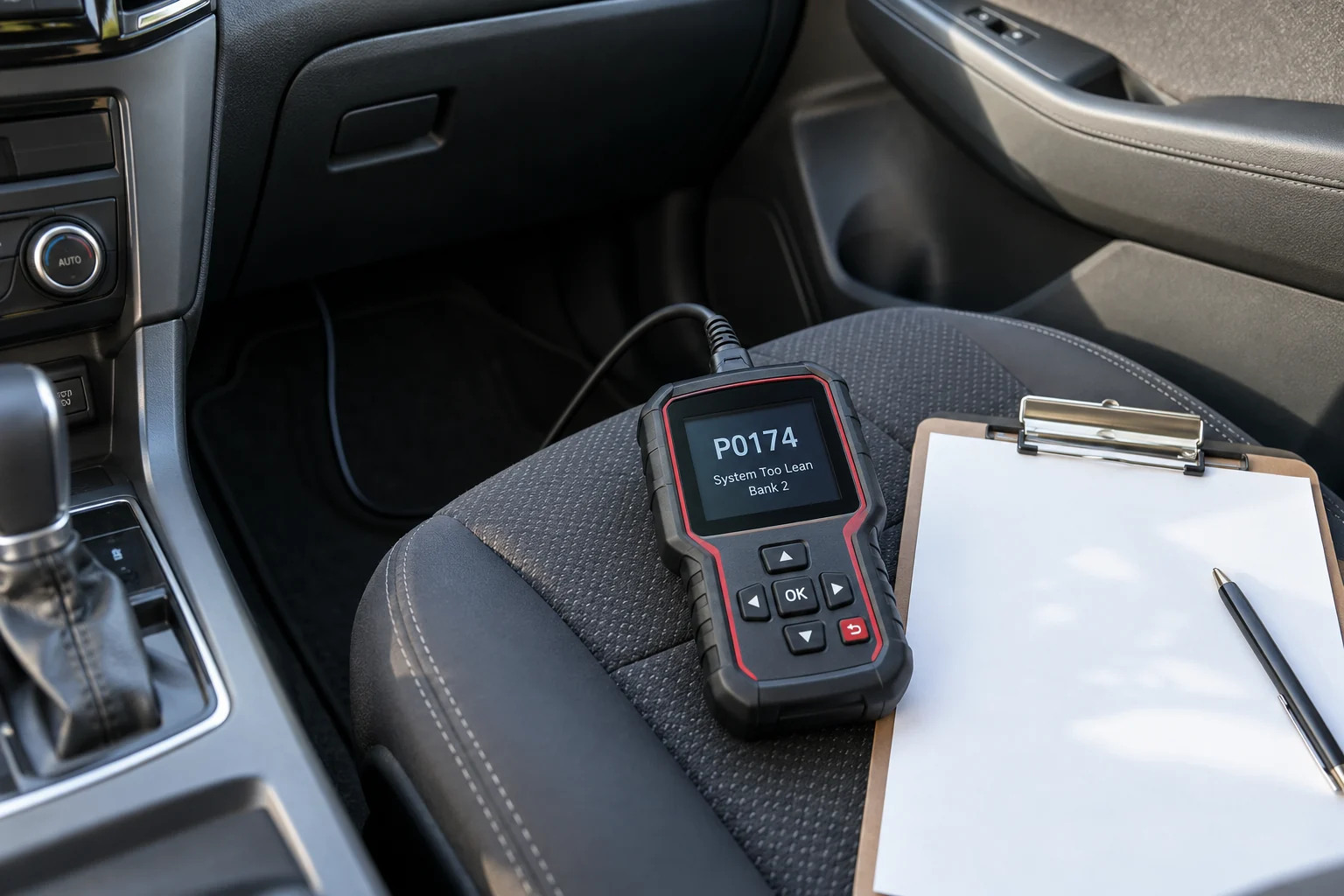
A screenshot of the code is useful, but the surrounding measurements can explain more than the five-character label.
P0174 alone or together with P0171?
P0174 identifies the Bank 2 warning; P0171 identifies a lean condition on Bank 1. When both appear, a shared cause is possible. It is still a diagnostic clue, not proof of one specific leak.
GM bulletin PIP4577K describes both codes appearing at roughly the same time on certain 2007–2009 Cadillac SRX, STS and XLR models with the 4.6L LH2 engine. It directs technicians to investigate air-induction leaks and other model-specific possibilities. That example does not establish the cause on a different Cadillac, a Chevrolet or a Ford.
What can cause the lean condition?
Documented possibilities include air entering where it has not been measured, faults around the intake or ventilation system, and fuel-system concerns. The relevant test sequence depends on the vehicle.
For its covered Cadillac applications, GM’s bulletin includes checks of ventilation connections, intake ducting, seals and fuel-system operation. These are workshop diagnostic areas, not a list of parts to replace in order.
Ford’s older bulletin compares fuel corrections under different operating conditions to investigate a vacuum leak. It specifically cautions that replacing oxygen sensors, the air-mass sensor or the control module will not repair an air leak. Leave those running-engine measurements to a technician who can apply the correct procedure.
Why a new oxygen sensor may not solve it
DENSO records a 2005 Toyota Avalon with P0171 and P0174 whose symptoms returned after both air-fuel sensors were replaced. The eventual cause was a cracked hose between the purge valve and intake manifold.
The DENSO case supports a practical question for the workshop: what test confirms the proposed failed part? It does not mean every P0174 has the Avalon’s hose fault.
Can you keep driving?
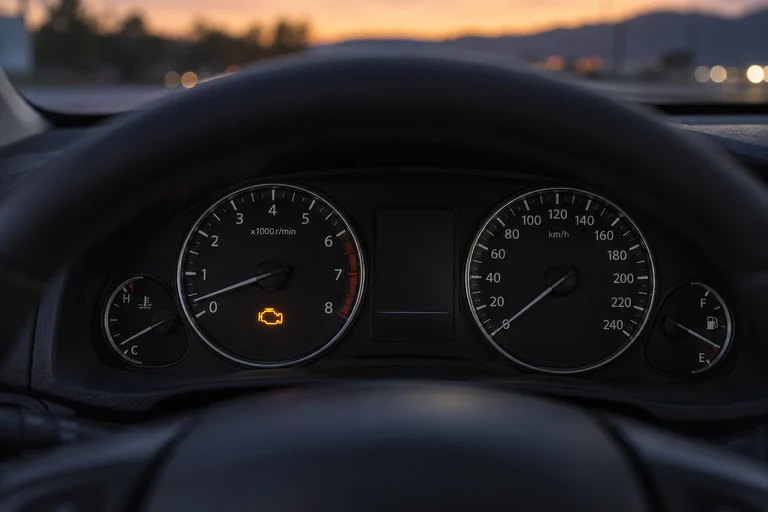
A code cannot provide a safe mileage allowance. Pay attention to the warning lamp and engine behaviour. The 2024 Ford F-150 owner’s manual warns that a flashing malfunction lamp can indicate misfire and possible catalyst damage; it calls for avoiding hard acceleration and prompt inspection. Follow your own vehicle’s warning instructions.
If the engine shakes severely, stalls or loses power, stop safely and seek assistance. With a steady lamp and normal running, arrange diagnosis rather than repeatedly clearing the warning.
Confirm the repair, not just a cleared display
Ask for the identified fault, the supporting measurements and the checks performed after repair. In DENSO’s example, verification includes a road test after replacing the damaged hose. A blank scanner screen immediately after erasing a code is not equivalent to a completed diagnostic check.
Frequently asked questions
Are P0171 and P0174 the same code?
They describe lean conditions on different banks: P0171 refers to Bank 1 and P0174 to Bank 2. If both are stored, preserve both results for diagnosis.
Does P0174 prove the Bank 2 oxygen sensor is faulty?
No. DENSO documents a vehicle where replacing the sensors did not fix the warning because a damaged hose was the cause. Diagnosis must establish whether the sensor is reporting a real mixture problem.
Should I erase P0174 before visiting a workshop?
Save the scan report and freeze-frame data first. Ford’s cited diagnostic bulletin requires the original data, which a reset can remove.
Check the original documents
Sources
- Ford gasoline OBD monitor summary, pages 18 and 105
Bank-specific P0171/P0174 definitions and fuel-trim monitor context; calibration limits depend on the system.
- Ford TSB 04-17-4, 13 August 2004
Only the listed Ford/Lincoln/Mercury applications: preserving freeze-frame data, vacuum-leak diagnosis and avoiding unconfirmed sensor replacement.
- GM bulletin PIP4577K, January 2012
2007–2009 Cadillac SRX, STS and XLR with 4.6L LH2: simultaneous lean codes and model-specific air/fuel diagnostic areas.
- DENSO: Lean codes after A/F sensor replacement
2005 Toyota Avalon example with P0171/P0174, a cracked purge-to-intake hose and post-repair road test.
- 2024 Ford F-150 owner’s manual: warning lamps
Flashing malfunction indicator, possible misfire and catalyst damage, and prompt inspection advice for this vehicle.
Sources checked on 2026-10-06. Follow the instructions for your exact model.